Sourcing from China - You must have realistic expectations because manufacturing is not perfect anywhere in the world.
Last updated: July 2026
I’ve been asked several times if I have learnt any valuable lessons while working as a sourcing agent in China. I don’t know if what I'm going to say is “valuable” or not, but here are two things I have learned to accept after working in the Chinese manufacturing sector over the years.
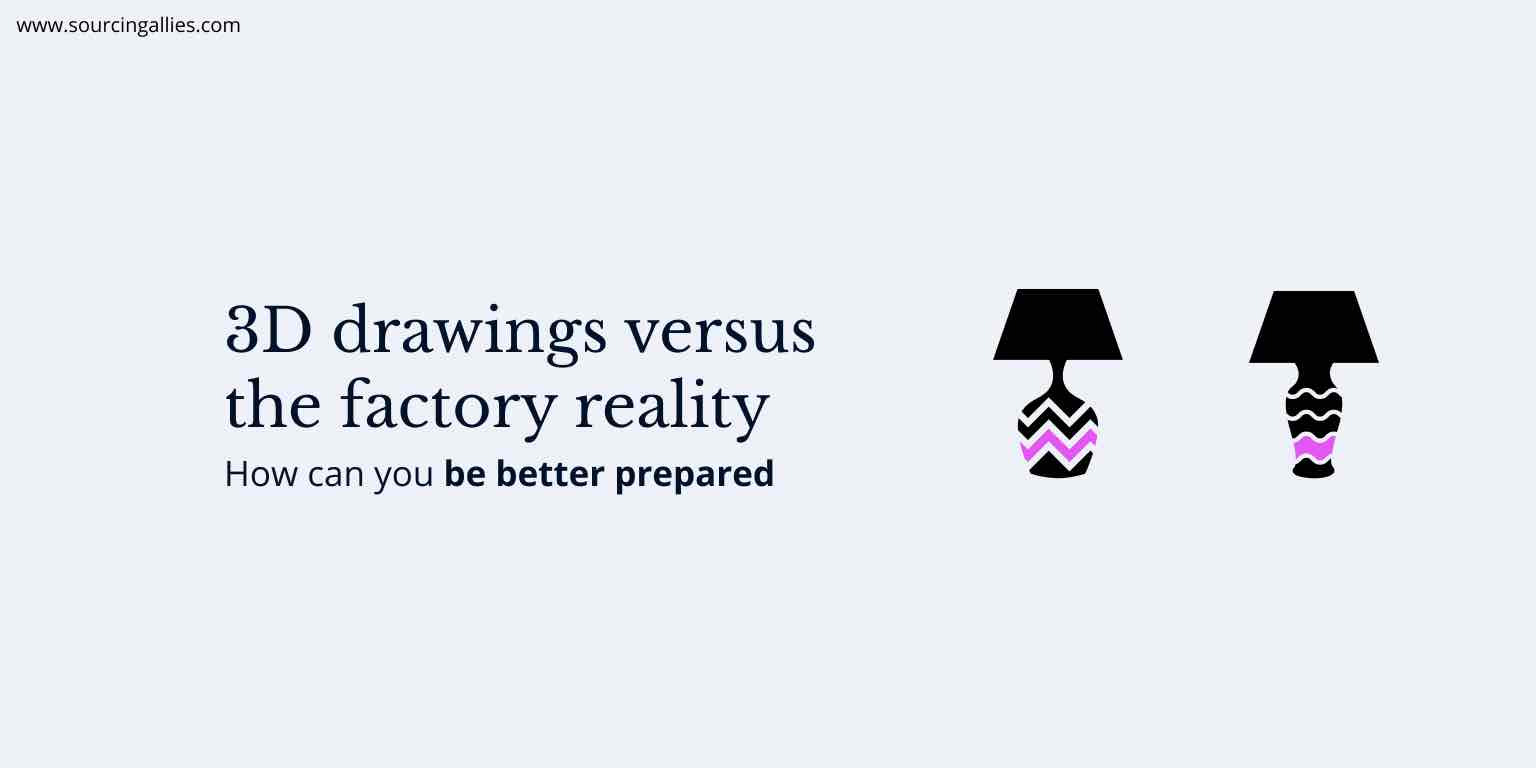
1. There will always be a mismatch between manufacturing theory such as 3D drawings and factory reality.
2. There will always be a mismatch between customer expectations on quality and the supplier’s willingness to manufacture that product to the exact product specifications.
Managing this relationship on a client's behalf, it is our job to negotiate these expectations. But even as we, at Sourcing Allies, harangue suppliers to ensure that the product specifications are as close to the client’s drawing specifications as possible, as an engineer with years of practical experience in manufacturing, I have some advice for customers looking at sourcing from China (or anywhere else in the world) too.
For one, I’d advise them to be realistic with their expectations and not insist that the product is made 100% according to the specifications in the 3D file. After all, the 3D file is “theory” and production is a different game, not just in China but anywhere else in the world. Minute distortions take place because of expansion and contraction, for instance, or because paint dries at a different rate depending on humidity, which can result in minor differences in the shade.
I’m not saying high-precision manufacturing cannot be done. Of course, it can. But that would be high budget manufacturing for, say, critical components used by the medical industry, and not a door knob or a tap that is going to be used in someone’s home that needs to be manufactured at a reasonable price.
Some customers don’t like hearing this, but that’s how it is.
So, how we deal with such customer expectations?
Let's say you are a new customer to China from the West. You send across a complicated drawing of some mechanical part that you want manufactured. This part has 100 dimensions on it. My response to this request would be honest. I’ll tell them upfront: “Well, there are 100 dimensions, so at least one of them is bound to be wrong after we have made it.”
I would then ask the client to tell me what are the critical dimensions in that part. We call them CTQ or critical to quality. These are the dimensions that absolutely must be within tolerance. Once those critical dimensions are set, in-process quality checks are what actually catch deviations before they become a bigger problem. Once we know what these dimensions are, we’ll ensure we get this right at least. But it is the client who must tell us which ones are critical to the functioning of that product or component.
While negotiating customer expectations and pushing the supplier to do their best job, we keep in mind the supplier’s tolerance to being asked to repeatedly redo a product to match exact specifications. After all, each manufacturer has a threshold after which he is unlikely to want to work with us to perfect the product because the effort required to put into it far exceeds the rewards.
We push them of course – a lot. But we also have to weigh up the risk and the frustration we are going to create by insisting that a product – say, a tap – is made 100% to the drawing specifications. The risk is that the supplier will just turn around and tell us that they are not prepared to invest the time to ensure the product meets the drawing specifications 100% and are willing to give up the order because it’s simply not worth their while.
This happens to us quite often because of our insistence on quality, and we end up going through suppliers quite a lot. This is, admittedly, all part of the game. But there are times when it is unnecessary and avoidable, and that only happens when the clients do not temper their expectations.
Having said that, we have helped our clients successfully manufacture an array of components such as complicated automotive parts to simpler products like door knobs since 2006, as part of a full manufacturing process that manages the relationship from drawings through to delivery. It is not difficult for sourcing projects to meet with success when clients pay attention to what really matters, and trust that we – as an experienced manufacturing partner – will ensure that they have absolutely no complaints.
If you're working through a specification that needs to hold tight tolerances on the details that actually matter, schedule a sourcing discussion and we'll talk through what's realistic for your product. We've been negotiating this balance between clients and factories since 2006.
Minute variation is a normal part of manufacturing anywhere in the world, not just in China — materials expand and contract, paint dries at different rates depending on humidity, and no production line turns out perfectly identical parts at scale. The goal isn't zero deviation; it's making sure the deviations that happen don't affect the dimensions that actually matter.
CTQ refers to the specific dimensions or features on a product that must stay within tolerance for it to function properly — as opposed to dimensions where small variation doesn't affect performance. Identifying which of your specifications are CTQ before production starts means a factory can focus its precision where it actually matters, rather than treating every dimension as equally critical.
By telling them directly which dimensions are CTQ and which have more flexibility. Factories can and do meet tight tolerances when it's worth their while — the key is not asking for 100% precision on every dimension, which raises cost and risk without a corresponding benefit to the product.
Yes, and it's worth taking seriously rather than dismissing as unwillingness. Every factory has a threshold past which reworking a product repeatedly to hit an unnecessary tolerance isn't worth the order to them. Pushing hard on the dimensions that genuinely matter is reasonable; pushing equally hard on everything risks the factory walking away from the relationship altogether.
We sometimes share case studies, learnings and webinars of our experiences when sourcing and manufacturing in China and Asia.


Whether you have a full set of CAD drawings or are already in production, we can help.


